Monday, November 11, 2013

Theodore Dwight Weld

I was born on September 23rd, 1803, in Hampton Connecticut. I grew up in a strict and religious household and went to academies where I learned about religion such as Andover Academy in Massachusetts and Lane Theological Seminary in Ohio. I was never close to my father and felt it was necessary that I to go into the study of religion. I worked as a travelling lecturer, a public speaker, where I witnessed slavery for the first time. Since then I joined the American Anti-Slavery Society. I thought the best place to speak against slavery was the West because they were only just developing as states and yet to have a collective opinion on the issue. I've traveled throughout the West and South and even back North where I've convinced and converted thousands, including members in the house. I assisted John Quincy Adams in his campaign against slavery in the House. My converts were a number of seventy and I taught them the sin freeing rightness of abolitionism. They traveled throughout the country spreading pamphlets I've made such as "The Bible Against Slavery".
My goal was to spread anti-slavery, abolitionism, to free the slaves ever since my first experience during my travelling. I joined Captain Charles Stuart and Charles G. Finney in a Holy Band of evangelists where I realized the sin of slavery. I then joined the American Anti Slave Society to work towards the emancipation of the slaves. I've used the words of the Constitution to reveal the hypocrisy and sin of the nation. Equal rights of the slaves is what I demanded because God gave life to all men with no condition of birth and no shade of color. Slavery is a sin against God
In my speeches I've told people the only way relieve America of it's sin is to follow the path of moral rightness and end slavery. The nation is not truly based on liberty because millions are denied freedom and basic rights. Free all the slaves and grant them equal rights as fellow human beings. Whoever robs a man of his rights overthrows justice, unsettles the foundations of human safety, and assumes the power of God. I was able to convert thousands of people, including members of the House and joined President John Q. Adams in his campaign against slavery in the House. There were times the AASS lost popularity due to our pamphlets coming on too strong. "Immediate Emancipation" brought protests and mobs to our feet. And with me losing my voice I was out of the speeches and was left to publish pamphlets and training converts. In my career I've published a few works but never under my name, the magazine Emancipator, the pamphlet "The Bible Against Slavery", and the book American Slavery as It Is.
Though my primary goal is abolition of slavery I've met a few women that would become leaders in the fight for women's rights such as Harriet Beecher Stowe, daughter of the head of Lane Seminary and writer, Angelina Gimke and Sarah Grimke, sisters who I met at Lane and joined the abolitionist cause. These three women were some of the earliest leaders in women's rights.
Education is another topic that complies with me. I've traveled teaching the people and youth of the nation to realize the wrong of the country to promise liberty and rights but not stay true when it comes to certain groups of people. Religious guidance was also an influence in my teaching and training throughout my anti-slavery movement.

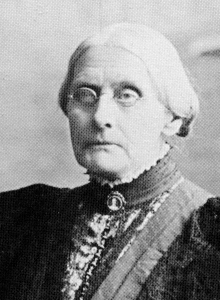
Susan Brownell Anthony


Personal Statement: Hi, my name is Susan Brownell Anthony, a feminist of my time who worked towards women’s rights. I was born on February 15, 1820 in Adams, Massachusetts. I was the daughter of Lucy Read and Daniel Anthony and was the second oldest of children: Guelma Penn, then me, then Hannah, then Mary Stafford, Eliza Tefft, Jacob Merritt, and lastly my youngest brother Daniel Reed. I was raised as a Quaker and I guess you could say that activism ran in my blood and at a young age I developed a sense of justice and moral enthusiasm. I did attend formal schooling at a local district school, but after the Panic of 1837, my older sister Guelma and I were taken out of school altogether at the ages of 17 and 18. I played a pretty major role in laying the foundation for women’s suffrage, sadly I did not get to see or experience it in the time I was alive.

Issue: I was the a champion of temperance, abolition and African American rights, rights of labor, and equal pay for equal work; although I was a busy woman, I devoted my life to organizing and leading women’s suffrage movement. At a young age, I experienced gender discrimination when, early in grade school a teaching refused to show me how to do long division simply because I was a girl, my teacher had no problem showing it to the boys in my class. Rights for all people is something very close to me and something that I think is worth the fight.

Solution: I taught school for fifteen years and then became involved in the temperance and anti-slavery movement, but since I was a woman I was not allowed to speak publicly. Because of this injustice, I became a leader in the movement for women’s suffrage. I tried to vote in in the presidential election and was criticized for it. Although I did not live long enough to see women’s suffrage in my life, I was successful in getting the women the right to vote. As early as 1893, 14 years after my death, the first women were allowed to vote in New Zealand.

Relationship To Others: I don’t discriminate, but at the dinner party I would be most comfortable holding a conversation with people who understand me and have similar beliefs as I do. With that being said, I would feel most comfortable with my fellow women’s rights activists like Margaret Fuller, Lucretia Mott, Angelina Grimke, and Elizabeth Stanton. Us girls would have so much to talk about!!

John C. Calhoun

Hello, My name is John C. Calhoun. I was born March 18, 1792 in South Carolina. I was the fourth child of Patrick Calhoun and Martha Caldwell. When I was Seventeen, I had to quit school to help my father's farm after he became ill. When I my brother gave me the money to return to my studies, I graduated college at Yale university and I studied Law. I eventually became Vice President under Adams and Jackson. I also was the secretary of State, and War. I was a senator and Representative for the great state of South Carolina.


Issue: I have an issue with the Tariffs placed upon us in South Carolina. The Abomination tariff impacts my State negatively. I believe that this tariff has been placed on us unnecessarily, and I believe it should be removed. I have my set of beliefs because of the tradition, culture and economic tendencies of my state. We already try and get a lot of work done so we have more crops and livestock to export, but these tariffs reduce our income and profit, making it harder for us to import goods.

Solution: I wrote the South Carolina Exposition in secrecy. This document was to help acknowledge our great disapproval of the Tariff. We eventually would nullify the tariff, but that only caused smaller ones to come in and consume us. I'm starting to think that the only effective way to end this problem is to secede from the union.

Beliefs and Relations: I'm very Pro-state and Pro-Slavery. I always wanted the peoples voices heard. I would feel comfortable sitting around people who live in the south, and like Slavery. I wouldn't feel comfortable sitting around northerns against slavery, or African Americans in the crowd. I feel like I would feel most comfortable sitting by Henry Clay, because, after all, I helped him with his American System. and We were War Hawks together. I feel that I would die if I sat next to Jefferson, because of the South Carolina Exposition that I wrote.

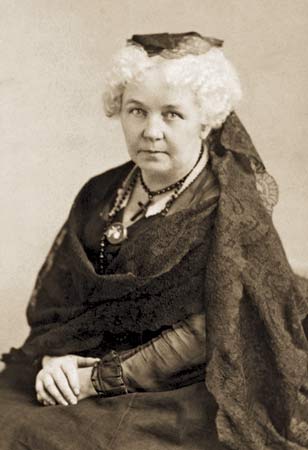
Elizabeth Cady Stanton

                                                 
File:Elizabeth Stanton.jpg

Personal Statement :
 Hello, my name is Elizabeth Cady Stanton and I was born on November 12, 1815, in Johnstown, New York. I attended Johnstown Academy, where I studied Latin, Greek, mathematics, religion, science, French, and writing until the age of 16. After graduating the academy, I went on to Union College, as my older brother, Eleazar, had done previously. I am the daughter of a lawyer who made no secret of his preference for another son. That is the reason for my desire to study and be equal as all the other males. I graduated from the Emma Willard's Troy Female Seminary in 1832 and I am drawn to the abolitionist, temperance, and women's rights movements through visits to the home of my cousin, the reformer Gerrit Smith. I believed in the expansion of the Fifteenth Amendment which includes voting rights for all women, this amendment also passed, as it was originally written, in 1870. I am also the author of the "Declaration of Rights and Sentiments" which granted rights to women and African Americans. 

Issue(s) :  

With Lucretia Mott and several other women, I held the Seneca Falls Convention in July 1848. At this meeting, we prepared the “Declaration of Sentiments” and took the lead in proposing that women be granted the right to vote. This declaration proposed grand movement for attaining the civil, social, political, and religious rights of women. Together with Susan B. Anthony, we declined to support passage of the Fourteenth and Fifteenth Amendments to the United States Constitution. I opposed giving added legal protection and voting rights to African American men while women, black and white, were denied those same rights. I authored both The Woman's Bible and her autobiography, along with many articles and pamphlets concerning female suffrage and women's rights. During the Civil War I concentrated my efforts on abolishing African American rights, but afterwards I became even more successful in promoting women suffrage. In 1868, I worked with Susan B. Anthony on the Revolution, a militant weekly paper. We then formed the National Woman Suffrage Association (NWSA) in 1869. I was the NWSA’s first president - a position I held until 1890. The organization then merged with another suffrage group to form the National American Woman Suffrage Association. I served as the president of the new organization for two years. My stance on the issue with women and slave rights is that the prejudice against color, of which we hear so much, is no stronger than that against sex. It is produced by the same cause, and manifested very much in the same way. My source of motivation is organized Christianity, which relegated women to an unacceptable position in society.

Solution(s) :
My solutions to the unfair rights to women and African Americans was traveling to give lectures and speeches. I called for an amendment to the U.S. Constitution giving women the right to vote. I also worked with Anthony on the first three volumes of the History of Woman Suffrage (1881–6). With my daughter, Harriet Stanton Blatch, we published a critique, The Woman's Bible, which was published in two volumes. The first volume appeared in 1895 and the second in 1898. This brought considerable protest not only from expected religious quarters but from many in the woman suffrage movement.  

Relationship to Others: 
I am passionate about women's rights and equality, so I would feel comfortable sitting next to someone with a related  opinion. I would also be comfortable sitting next to atavists with religious leanings supporting divorce rights, employment rights, and property rights for women. I believe fundamental sexism is part of organized Christianity. On the other hand, I would feel very uncomfortable sitting next to someone who would deny any rights to women and African Americans. Someone who believes women should obey the man and neglects women capability.         


Margaret Fuller

Personal Statement:
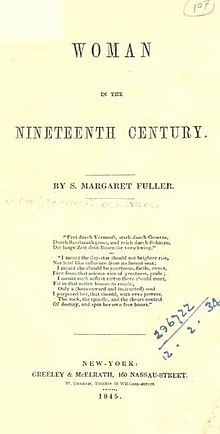
  • My name is Margaret Fuller, and I was born on May 23, 1810 in Cambridge, Massachusetts. At a young age, my father, determined to give me a proper “boys education”, began teaching me how to read and write and continued to be my teacher until he got elected as a representative in Congress in 1817. I began my formal education at the Port School in Cambridge in 1819, and then continued my education at the Boston Lyceum for Young Ladies from 1821 to 1822. To fulfil my aunts and uncles wishes, I attended the School for Young Ladies in Groton for two years, until I realized I did not fit in with young woman my age and decided to go home at the age of 16 and teach myself. Early on in life I realized that the one thing I loved to do was read. I earned my reputation as best-read person, male or female, in New England, and was the first woman allowed to use the library at Harvard College. I delivered private lessons, and made my keep through journalism and translation. In November of 1839, I began overseeing what I like to call “conversations” with local woman in Boston, centered to make up for lack of women's education with discussions and debates on specific topics. I sought to answer great questions facing womankind, and had significant figures from the women’s rights movements attend my conversations. I was known as an important figure in the transcendental movement, due to my job as the editor of Ralph Waldo Emerson’s The Dial. Soon after, I wrote the first book on American feminism named Woman in the Nineteenth Century. I became a well known literary critic and the first full time book-reviewer in American Journalism.

Issue:
  • I was a very strong proponent of feminism and women's rights. The source of my motivation, mainly, was women's education and right to employment. I believe that woman should be provided a proper education and equal political rights. They should also be able to seek any type of employment they want and not succumb to the “feminine” roles, such as caregiver or teacher.
Solution:
  • Giving my best effort to support feminism and help the woman in my country achieve a better lifestyle, I started overseeing what I like to call “conversations” with woman in my community. These conversations were focused on making up for the lack of education among women by discussing and debating on a wide variety of topics. In these meeting, I wanted to answer the great questions facing womankind and help them get a better future.
  • I have been very successful in spreading my opinion and knowledge on this topic. The “conversations” helped women achieve a more well rounded education on certain topics, and I also was a great literary critic and book-reviewer, so I got to show the world my opinion on my favorite topics. Aside from being a reviewer and journalist, I also wrote the first book on American Feminism and set a trend for many women's activists to come.
  • While trying to spread my knowledge and position on this certain topic, I faced many challenges. From being taught a “boys education” from my father, my father's death making my abandon many of my ideas in order to travel back home and care for my family, poor salary, and physical sickness among others.

Relationship to others:
Comfortable- Susan B Anthony, Elizabeth Cady Stanton, Ralph Waldo Emerson, Horace Greeley.


Not Comfortable- Anyone who opposed feminism and transcendentalism

Henry David Thoreau

Personal Statement: Hi, my name is Henry David Thoreau. I was born in 1817 in Concord, Massachusetts with my parents John and Cynthia and my siblings  Helen and John Jr. I went to Harvard with the help of my brother paying off my tuition with his salary as a teacher. After graduating Harvard I went into teaching then opened up a school with my brother. After it closed I kept my family’s pencil business and that was my way of getting a living. Also, I moved in with a close family neighbor, Ralph Waldo Emerson. I always saw myself as an aspiring and philosophical writer through college and kept a journal of different poems, essays, and reviews that were about nature and philosophy. Later I decided to move into the woods in shack near Walden pond to experience life isolated from the world. Here I spend my two years observing nature, and putting everything to paper. That’s where I wrote Walden (1854) which is a set of essays on the environmental movement. Walden is my greatest achievements that also sets a basis for the environmentalist. You could say I was the father of the Environmental Movement. During the Civil War, specifically the Mexican War, I refused to pay toll taxes. I was too upset because of the Civil War I didn't want to give money to the government. Essentially if you don’t pay your taxes you get put in jail. In jail I wrote in my journal several essays and other writings. A certain essay I wrote was called “Civil Disobedience.” This was primarily about fighting for what you believe in without the physical violence. If you jump to a bunch of years later, this influenced people like Gandhi, Rosa Parks, and Martin Luther King Jr.

Issues: Transcendentalism began as a radical religious movement and a new way of thinking when people were upset by how the Unitarian Church was running and turned to nature. Transcendentalists, as in me, believed that an individual could be more powerful than the institution itself, like a church. Meaning that in every person’s mind was a larger and powerful voice (god), and there was no reason for a church.  Transcendentalism also goes hand in hand with nature. Nature is pure and significant and also nature is self-knowledge. Your mind and nature is all you really need. Its not logic, its something you are born with. I also supported individualism, and that politics and strict religion came in between a person’s influences. I praised the abolition movement as well, and supported the anti-slavery groups.

Solutions: I believed strongly in Transcendentalism and nature as a way of life. Also because of my passion for nature I hoped to spread environmental movements with Walden. Because the church and politics were so corrupt I hoped to bring people to the sense of becoming individualistic. And for my hatred with political parties I relied on my essays on individualism and civil disobedience to spread the realization of fighting without the violence. This allowed for revolutionary heroes to grow, as mentioned before, Gandhi, Rosa Parks, and Martin Luther King Jr. That to me makes me a successful person, because all in all, I made an influence and helped made a change even if it was after my death. In addition, as a Transcendentalist I hoped to achieve the goal of relating the natural world to the individual’s world they have inside themselves.

Relationships: I would be most comfortable talking to Ralph Emerson, Margaret Fuller, Theodore Parker, at the dinner party. I would not be comfortable sitting next to Joseph Smith and Henry Clay.

Sylvester Graham


Personal Statement
Hello, my name is Sylvester Graham. Yes, just like the crackers (probably because I did invent them). But before I had created this source of high nutritional value, I was born on the 5th of July in the year 1794 in West Suffield, CT. My father was a clergyman at 72 years of age when I was born as his 17th child, then he shortly died while I was a toddler. This could’ve been the start of my mother’s emotional and mental trauma. I was sent to live in various households because of her instability, I sought out different vocations but I turned to following my father’s footsteps, I joined the ministry, becoming a Presbyterian clergyman. I had entered Amherst College in 1823 but I failed to graduate. Around this time, I had married a woman named Sarah Earl then I joined the Pennsylvania Temperance Society. I had a following called The Grahamites, they supported my nutritional and sexual views. However, even if I did have a good amount of followers, I still received harsh criticism from the media, butchers, and commercial bakers.

Issues
I took after William Metcafe’s ideas of vegetarianism and abstinence. I concerned myself greatly with the Dietary Reform of the Antebellum of the United States, and argued that chemical additives within bread was unwholesome. Use of alum and chlorine to whiten bread though was a common practice among bakeries, causing commercial bakers to hate me. In regards to abstinence, the public and the media thought I was unbecoming of a minister because I spoke so freely about sexual ideas. Some even claim that women have fainted during my lectures because of my opinions on corsets.

Solutions
I believe that an unhealthy diet could lead to increased libido. Therefore, having good nutritional values would lead one to a healthy life free of sexual constraints. Although a lot of people criticized me for my opinions and how I aired them, I stand firmly by them. In fact, I had to leave ministering to pursue being an in-demand lecturer. I had a lot of ideal lifestyles, such as: taking frequent showers in cold clean water, hard mattresses, vigorous exercise, and loose clothing. I was highly in favor of temperance; however, I was often overworked to the point that I had to retire lecturing in 1839 then worked as a writer struggling with emotional and mental issues, similar to my mother. But even with these obstacles, I managed to co-found the American Vegetarian Society in 1850, and published “Lectures on the the Science of Human Life” and “Lectures to Young Men on Chastity”. In the process, I had influenced a lot of people and their nutritional views, one notable figure being John Harvey Kellogg, a man who was later to be known for his breakfast cereals.

Relationships With Others
I had heard that Mary Cheney was an advocate of Graham’s Diet (avoiding meat, alcohol, and spices), so I think it would be interesting to sit next to her (supposedly oppressive) husband, Horace Greeley. I think it would be lovely to sit next to Mother Ann Lee because of our common protest against sexual relations. I would hate to be seated next to Ralph Waldo Emerson because he mocked me in one of his editorials calling me the “poet of bran and pumpkins”.