Showing posts with label Women's Suffrage. Show all posts

Monday, November 11, 2013

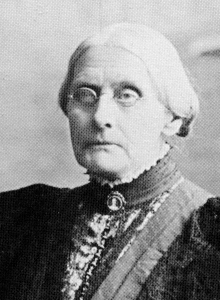
Susan Brownell Anthony


Personal Statement: Hi, my name is Susan Brownell Anthony, a feminist of my time who worked towards women’s rights. I was born on February 15, 1820 in Adams, Massachusetts. I was the daughter of Lucy Read and Daniel Anthony and was the second oldest of children: Guelma Penn, then me, then Hannah, then Mary Stafford, Eliza Tefft, Jacob Merritt, and lastly my youngest brother Daniel Reed. I was raised as a Quaker and I guess you could say that activism ran in my blood and at a young age I developed a sense of justice and moral enthusiasm. I did attend formal schooling at a local district school, but after the Panic of 1837, my older sister Guelma and I were taken out of school altogether at the ages of 17 and 18. I played a pretty major role in laying the foundation for women’s suffrage, sadly I did not get to see or experience it in the time I was alive.

Issue: I was the a champion of temperance, abolition and African American rights, rights of labor, and equal pay for equal work; although I was a busy woman, I devoted my life to organizing and leading women’s suffrage movement. At a young age, I experienced gender discrimination when, early in grade school a teaching refused to show me how to do long division simply because I was a girl, my teacher had no problem showing it to the boys in my class. Rights for all people is something very close to me and something that I think is worth the fight.

Solution: I taught school for fifteen years and then became involved in the temperance and anti-slavery movement, but since I was a woman I was not allowed to speak publicly. Because of this injustice, I became a leader in the movement for women’s suffrage. I tried to vote in in the presidential election and was criticized for it. Although I did not live long enough to see women’s suffrage in my life, I was successful in getting the women the right to vote. As early as 1893, 14 years after my death, the first women were allowed to vote in New Zealand.

Relationship To Others: I don’t discriminate, but at the dinner party I would be most comfortable holding a conversation with people who understand me and have similar beliefs as I do. With that being said, I would feel most comfortable with my fellow women’s rights activists like Margaret Fuller, Lucretia Mott, Angelina Grimke, and Elizabeth Stanton. Us girls would have so much to talk about!!

Harriet Tubman


Personal Statement:
I was born Armanita Harriet Ross to slave parents, Harriet Green and Ben Ross, in Dorchester County, Maryland in the 1820’s. Back then it wasn't important to keep documentation of our(the slaves) birth, so I don't know the exact date.I grew up as a slave , and my entire family was enslaved. I worked fro the Brodess family. Even with 9 children, including myself slavery still tore us apart. I married a free black man named John Tubman around 1844, and not far after, I changed my name to Harriet. I had seizures, delusions, and narcoleptic attacks due to a head injury so my owner tried to sell me, but a week later Brodess died. Following his death, my brothers and I fled on September 17, 1849 because we knew we were going to sold. Edward’s widow, Eliza, posted a runaway notice offering a reward for each of us to be returned. We went back on our own, together. However, I managed to escape one more time with the help of the Underground Railroad.The Underground Railroad was a long, taxing trail for slaves to freedom. I took over 19 trips on the railroad looking for m family and helping over 300 slaves to freedom in the process. In 1851, I returned to Dorchester County for the first time since my escape to find my husband John,but he was married to another woman and did not want to come with. In November 1860, I was in search of my sister and her two children as my last trip. When I made it back I found that she had died, and that I did not have enough money to free her kids. So, I made my way up back north with a group of fugitives. I finally settled in Auburn, and married a man named Nelson Davis, a war veteran.
In 1874 we adopted our baby girl Gertie.

Issue: 
I went against slavery and the fugitive slave law.

Solutions:
Helped over 300 slaves to freedom through the Underground Railroad, and helped more flee to Canada after the fugitive slave act was passed. I joined a group of abolitionists, then assisted fugitives in Port Royal and serving as a nurse. I accompanied Montgomery and his troops in rescuing more than 700 slaves-- being the first woman to ever do something like that. For two more years I worked for the Union forces, then when the war was over I returned to my home in Auburn, New York. In my later years, I worked to promote women’s suffrage. I began attending meetings of suffragist organizations, and I was soon working alongside inspirational women like Susan B. Anthony and Emily Howland. I traveled to New York, Boston, and Washington, D.C. to speak out in favor of women’s voting rights.
Relationships with Others:

I would sit with Susan B. Anthony, Emily Howland, and anyone else like them.

Susan B. Anthony

Personal Statement: I am Susan B. Anthony, born in 1820 in Adams Massachusetts. I am the second of seven children, all raised as Quakers and taught hard work and a simple life. I received formal education at the local district school, and for a period I was home-schooled, however, after the panic of 1837 me and my sister, Guelma, were taken out of school. I am a civil rights leader and feminist who played a primary role in introducing women's suffrage to America.  I did not get to see women's suffrage achieved during my life time however my work laid it's foundation.


Issues: I was involved in anti-slavery and temperance movements along with my work for women's suffrage. My father was an abolitionist and after my family and I moved to Rochester anti-slavery Quakers would meet at our farm almost every Sunday and occasionally we would be joined by Fredrick Douglass and William Lloyd Garrison. Because of this early exposure I became an agent for the American Anti-Slavery Society. In 1863 Stanton and I organized the Women's National Loyal League in our support of the 13th Amendment that would outlaw slavery. I worked strongly with anti-slavery and then after hearing Lucy Stone speak about women's rights I was persuaded to devote my life to that very issue. Then in 1866 Stanton and I founded the American Equal Rights Association to make publications about women's rights and equality. During the 1872 Presidential Election I took a remarkable step and I voted. I was later tried and convicted and charged a $100 fine which I refused to pay because I believed it to be an unjust penalty. In 1887 the two women's rights groups joined to become the National American Women's Suffrage Association.


Solutions: In my work against slavery I collected petitions against the Gag rule that had been introduced which prohibited anti-slavery petitions in the House of Representatives. On the issue of women's rights I gave speeches and created the Women's National Loyal League and the American Equal Rights Association which became the National American Women's Suffrage Association. I was criticized after  I was tried following my attempts to vote in the presidential election. My work for women's suffrage was eventually successful. I knew very well that I would not live to see the day that women were legally given the right to vote, but it wasn't until 14 years after my death that women were finally guaranteed the right to vote.


Relationship to others: At the dinner party I would be most comfortable talking to people who share similar beliefs. Such as I would be comfortable with Lyman Beecher because of our similar beliefs when it comes to temperance. Also because of similarities in abolition beliefs I would be comfortable with Charles Finney, Henry Thoreau, Harriet Tubman and my fathers old friends William Lloyd Garrison and Frederick Douglass. I would be comfortable with Catharine Beecher because she also believes in equal education for men and women. I would be especially comfortable with my dear friend Elizabeth Stanton and other women's rights activists like Lucretia Mott, Margaret Fuller, and Angelina Grimke.

Lucretia Mott


Personal Statement:

      My name is Lucretia Mott. I was born on January 3, 1793 in Nantucket Massachusetts and died 87 years later on November 11, 1880. I was born and raised in a Quaker family. At the age of 13 I went to a boarding academy in the Hudson Valley. Soon after I graduated from this Quaker Academy, I became a teacher there. Fortunately for me after several years I met my husband to be, James Mott. James and I ended up raising 6 beautiful children, unfortunately one of our children died early. Throughout my time, I was recognized as one of the first public figures that believed, and spoke out for both slavery and women's rights. I was known for being highly outspoken, and a suffragist for women's rights by the people. I helped organize women's abolitionists societies to strengthen my beliefs considering anti-slavery organizations would not allow women to contribute, or become members. I was very passionate about my what I believed in and I protested for it. I didn't pay consideration to the criticism of others, instead I stuck strongly to my beliefs. My words inspired people to stand up and to speak up for their beliefs as well. People respected me for working so hard. In the year 1840, the World's Anti-Slavery Convention in London selected me as their delegate. A women by the name of Elizabeth Cady Stanton and I decided to hold a mass meeting in order to address the women's right, while we where in the segregated women's section. In July of 1848 Elizabeth and I began the Seneca Falls Women's Rights Convention. In 1848 we wrote the Declaration of Sentiments. It was signed by 68 women and 32 men. Our main principle was that women and men were both created equal. This was a very big moment for me along with being the first female president for the American Equal Rights Convention after the Civil War. I tried to help people as much as possible, and thus made speeches based on slavery and women's rights. 

Issues:

      I am a strong supporter in the abolition of slavery. I believe that slavery was a terrible idea, and that women needed to have more rights. In order to express my strong beliefs I boycotted all salve labor products. Elizabeth and I began to get more involved in women's rights after the Anti-Slavery convention. I also believed that people should all have equal economic opportunity. I enjoyed supporting women's equal political status, also including suffrage. Many of the issues that I believe are all discussed in my book. In 1850 Discourse on Women, my book, was published and it talked about the many issues that I believed in. Most of my beliefs are also influenced by my background, being a Quaker.

Solutions:

      My goal is that I was able to influence others into standing up for their beliefs. I worked hard to speak out for American Equal Rights, and thanks to Elizabeth Stanton, I became a leader in the women's rights movement. I hope that the many speeches and sermons I delivered affected many listeners. I believe I was successful because due to all of the projects I took on I ended up winning first president. My other accomplishments were that I helped find Swarthmore College in 1864, and after this hard work I continued to attend women's rights conventions. In 1869 I was even able to re join the conventions when they split into two. Considering the act that I faced many difficulties in my accomplishments, I still overcame them and became the first public speaker for women's rights. I tired to show people that the only effective way to be equal and have fair rights was to include women and abolish slavery, and even though I was denied a seat in the World Anti-Slavery Convention, I hope I was still able to get this pint across. 

Relationship To Others:

      I would feel comfortable sitting next to Elizabeth Cady Stanton, Fredrick Douglass, William Lloyed Garrison, and Theodore Parker due to them also being against slavery in some way. I would, however; not be comfortable next to Andrew Jackson and John C. Calhoun because they both supported slavery. 

Susan B. Anthony

Susan B. Anthony 
Personal Statement:
I was born on February 15th 1820 in Adams, Massachusetts. I was the 2nd of the 7 children my father, Daniel Anthony, and mother, Lucy Read, conceived. My received my primary education from home schooling, but in 1837, went to Deborah Moulson's Female Seminary to continue my education. I am considered notable because I helped women's suffrage become a reality, even though I didn't see the law passed in my lifetime. Historically, I was the first women to vote, and left a lasting mark on the lives of women in America. I helped them gain their right to vote.

Issue:
  In the beginning of my life, I spend much time advocating the temperance movement. Being a Quaker, drunkenness is seen a sin to me, and therefore, my involvement in the temperance movement had religious motives.  However, my father was a liberal Quaker and abolitionist, and when we moved to Rochester New York in 1845, anti-slavery meetings frequently took place in our house. My involvement in the abolitionist movement also had religious motives. In Rochester, I also began teaching. The unfair pay of women teachers began to spark my interest in the women's suffrage movement. It just isn't right to pay women $2.5 a month when a man is receiving $10 a month. In 1848, I attended my first women's suffrage convention in Seneca Falls, N.Y. Around the same time, my father's friends, William Lloyd Garrison, Frederick Douglass, and Wendell Phillips, would visit and discuss in the house. They also helped shape my views on slavery, temperance, and women's suffrage. Until 1851, I spent much of my efforts rallying for the temperance movement. However, when I was denied the right to speak at a rallies because I was a women, I then realized that I had to gain my rights, both freedom of speech and ability to vote, in order to achieve any real success with the other causes. Around this time I met Elizabeth Candy Stanton, and the two of us would later organized the National Woman  In the beginning of my life, I spend much time advocating the temperance movement. Suffrage Association in 1868. However, with the outbreak of the Civil War, I helped the abolitionist movement. When women still had not gained the right to vote by the end of the war, I focused on the women suffrage movement. Stanton and I began writing a weekly newspaper called Revolution which advocates women's rights. However, by 1872, enough was enough so I registered and voted for the 1872 presidential election. Though I was arrested, tried in court, and fined $100, it was worth it. Continuing on my journey to suffrage, Stanton, Matilda Gage, and I began writing History of Women's Suffrage,  which eventually had 6 volumes. I founded the International Council of Women in 1888, which met in both London and Berlin.

Solution:
The only solution to slavery and lack of women suffrage would be legislation. The abolition of slavery was seen at the end of the Civil War, and, though not in my lifetime, women gained their right to vote in 1920. Temperance, however, was solely a moral issue. I did not advocate Prohibition because the issue of women's suffrage was far more important.

Relationships:
 I would feel comfortable sitting with anyone who supports the temperance, women suffrage, and abolitionist movement. Especially, I would love to sit by Elizabeth Candy Stanton, because she was a lifelong friend that helped me fight for women's suffrage. Frederick Douglass, William Lloyd Garrison, and Wendell Phillips would also be fine people to sit with because they were also involved in the anti-slavery movement. It would also be nice to sit by Matilda Gage because she supported the women's suffrage cause and wrote History of Women's Suffrage with me. I would feel comfortable with anyone who supported my causes, including David Walker, Harriet Truman, and Sojourner Truth. I would not want to sit with anyone who opposed women's suffrage or abolition, especially Josephine Dodge because she formed the National Association Opposed to Woman Suffrage. Also, I would not was to sit by Calhoun because he is pro-slavery.

Angelina Grimke


Personal Statement: My name is Angela Grimke and I was born in Charleston, South Carolina on February 20th, 1805, my family's 14th child. As my high social status entails, I was educated at privately and at home. I eventually grew tired of my role as a woman in Charleston. Some of you might remember my work in charity, religion and abolition of slavery.

Issue(s): I was involved in the issues of abolition, women's rights, and charity. In the instance of the abolition of slavery, I maintain that abolition is the right choice when dealing with slaves. Slaves and women deserve equal rights as well. To show my support for abolition, I joined the Philadelphia Female Anti-Slavery Society. I also published a piece for the American Anti-Slavery Society called An Appeal to the Christian Women of the South. Being a Quaker it is my duty to express my solemn sincerity in charity and the abolition of slavery. As a woman, it is my duty to express my opinion on women's rights.

Solution(s): The solutions to all these problems are individual moral reform and legislation. If legislation can pass a law that abolishes slavery and the law was enforced, I do believe that there would be opposition, but the problem would be half dealt with. Legislation can also contribute a major change in women's rights such as including our rights in the Constitution and pass laws in favor of women's suffrage. These may seem like radical changes to the South's way of life, but they are necessary to successfully accomplish these goals. Individual moral reform is also a perfect solution to the problem of abolition and women's rights because if people (AKA men) changed their minds and implemented women's suffrage, then the women could involve themselves in politics more and bring about a stronger anti-slavery movement. My role in activism did prove successful in the way that it spread information and changed people's minds. In the end, my dream of abolition was realized. Some struggles I faced along the way was criticism from the South and mostly men.

Relationship with Others: I am closely related to women's rights activists, slavery abolitionists, and Quakers. I feel least comfortable talking to chauvinists, slave owners, or any advocates of slavery. Another reform going on at the time that I inadvertently supported was the Education reform. I supported it because I believe in an education for both boys and girls, one that extends to the college level.

Wendell Phillips

Personal Statement:

My name is Wendell Phillips. I was born on November 29, 1811 in Boston into a wealthy family.  My mother was Sarah Walley and my father was John Phillips. My father was a successful lawyer, politician and a philanthropist. Being apart of a wealthy family allowed me to acquire a great deal of formal education. I attended Boston Latin School and later attended Harvard University, from which I graduated in 1831. In 1834, I received my law degree from Harvard and was admitted to the Massachusetts state bar. I, however, did not pursue this career as Ann Terry Greene, whom I married on October 12, 1837, introduced me to the abolition movement. Once I had been introduced to this movement, I quickly became involved. I joined the American Anti-Slavery Society where I became a close associate of the abolitionist leader William Lloyd Garrison, wrote multiple pamphlets speaking out against slavery and wrote editorials for Garrison’s The Liberator. I also gave a speech denouncing the murder of antislavery editor Elijah P. Lovejoy. This impromptu speech and many others are what earned me the nickname as the “golden trumpet” of the abolition movement. I continued to fight for social justice, even after the emancipation of the slaves. I was a prominent leader in the abolition cause and I was able to rally many together to help support the cause. I was a key contributor to the passing of the thirteenth, fourteenth, and fifteenth amendment. I not only advocated for the abolition movement, but many other issues as well such as education. I have pushed for free public education in the south for children of all backgrounds.

Issue(s):

Throughout my lifetime, I was predominately involved in the Abolition Movement. I am an abolitionist that believes that the institution of slavery is unjust and should be abolished. I believe that the Constitution is corrupt, in that it supports the institution of slavery. I understand President Lincoln's desire to keep the nation united, but I strongly believe that it is more important to free the slaves than to preserve the Union.

Solutions:

I believe that the time of nonresistance has passed and it is time to utilize every form of defense that we posses to resist laws such as the Fugitive Slave Act(1850). Though after the passage of the thirteenth amendment, I saw potential in political reform through the formation of new legislation. I then pushed for the passage of the fourteenth and fifteenth amendments. I have been very successful in my efforts, as the thirteenth amendment was passed abolishing slavery and freeing the slaves. The passage of the fourteenth and fifteenth amendment are also part of my success, as they have given the African Americans equal rights, along with the right to vote. My choice to jump into the Abolition Movement caused me to become a disgrace to my parents and I was turned away from them.

Relationship to Others:

Though my primary focus was on the Abolition Movement, I was also in favor of many other reforms occurring in the nation. I was in full support of Temperance and played a key role in the reform for women's rights. I pushed for free public education for children, and believed change had to occur in the prison system. At the dinner party, I would be most comfortable talking to William Lloyd Garrison, Henry Thoreau, Susan B. Anthony, and Elizabeth Cady Stanton. I would feel uncomfortable next to Henry Clay.


Harriet Tubman


Personal Statement:
My name is Harriet Tubman. I was born Armanita Harriet Ross to slave parents, Harriet Green and Ben Ross, in Dorchester County, Maryland in the 1820’s. There are no records of my birth, so I don’t quite know exactly when I was born. As a child, I took care of a younger brother and a baby, under the commands of a woman named Mary Pattison Brodess, who would beat me if I didn’t do my job right. My owners ran a large plantation near Blackwater River in Madison, Maryland, so as I grew older and stronger, I was assigned to bigger tasks in the field and forest. My mother, Rit, worked as a cook for the Brodess family, and my father, Ben, was a woodsman on the plantation. They had 9 children, including myself. However, our family struggled to stay together as slavery tore us apart. In my early life, I suffered a severe head injury when I was hit by a heavy metal weight. The injury caused seizures, narcoleptic attacks, headaches, powerful visionary, and dream experiences which occurred regularly throughout the rest of my life. Doctors believed I may have suffered from temporal lobe epilepsy, however, being a devout Christian, I liked to view my vivid dreams and visions as revelations from God. Around 1844, I married a free black man named John Tubman. Soon after the marriage was when I changed my name from Araminta to Harriet. In 1849, I became ill and my owner, Edward Brodess, unsuccessfully tried to sell me. A week later, Brodess died. Knowing we would all be sold, my brothers and I escaped from slavery on September 17, 1849. Edward’s widow, Eliza, posted a runaway notice offering a reward for each of us to be returned. My brothers managed to persuade me to return back with them. However, I managed to escape one more time with the help of the Underground Railroad. Along my way, I managed to help rescue more than 300 slaves. I took them on an exhausting and dangerous journey of nearly 90 miles, traveling by foot, northeast along the Choptank River, through Delaware and north into Pennsylvania. After I reached Philadelphia, I began thinking of my family, who still weren’t free even though I was. I began working any jobs I could find in order to save money. At this time, Congress passed the Fugitive Slave law of 1850, which forced law enforcement officials, even in states that had outlawed slavery, to aid in the capture of fugitive slaves, and imposed heavy punishments on those who aided escape. This, for us fugitive slaves, meant that we had to try to get to Canada, which had abolished slavery. That winter, I received a warning that my niece and her children were going to be sold, so I returned to my land of enslavement. They managed to escape, meeting with me so I could bring them safely to Philadelphia. In the spring, I headed back to Maryland to help rescue other family members. I began making more and more trips back to rescue all of my family members, while helping others along the way. In 1851, I returned to Dorchester County for the first time since my escape to find my husband John, who was married to another woman. I insisted they both return back with me but John refused, claiming he was happy where he was. As angry as I was, I respected his decision and instead found other slaves who wanted to escape and led them back to Philadelphia. In December of 1851, I guided 11 fugitives northward. For 11 years, I returned repeatedly to Maryland, rescuing about 300 slaves in my 19 expeditions. I also provided specific instructions for about 50-60 other fugitives to escape to the north. Despite my dangerous actions, I was never caught, and neither were the fugitives I guided. One of my last missions was to retrieve my aging parents. My father freed my mother when he purchase her from Eliza Brodess. Two years later, I received word that my father helped a group of escaped slaves and was at risk of arrest. So, I traveled to them and led them into Canada. In November 1860, I went on my last rescue mission. I was in search of my sister and her two children. Upon returning to Dorchester County, I discovered that Rachel had died, and I wasn’t able to save the children because I had no money to pay for their release. Not willing to waste my trip, I gathered another group of fugitives and we were well on our way north. I spent my remaining years in Auburn, tending to my family and others in need. I worked different jobs to support my parents and pay bills. I soon fell in love with a Civil War veteran named Nelson Davis. Even though he was 22 years younger than me, I married him in 1869 and we spent the next 20 years together. In 1874 we adopted a baby girl named Gertie.

Issue: 
Along my life long journey, I stumbled upon many issues. I fought against slavery and the fugitive slave law, and fought for women’s suffrage and civil rights. In being very religious, most of my goals towards these issues came from my strong beliefs in God and the Bible.

Solutions:
Escaping slavery, I made more than 19 missions to rescue more than 300 slaves using the Underground Railroad. I returned many times to rescue my family members still enslaved, guiding dozens of other slaves to their freedom. When the South passed the Fugitive Slave Act of 1850, I helped guide fugitives farther north into Canada where slavery had been abolished. I later helped John Brown recruit men for his raid on Harpers Ferry. When the American Civil War broke out in 1861, I saw a Union victory as a key step toward the abolition of slavery. I joined a group of abolitionists heading to South Carolina. I became a fixture in the camps in Port Royal, assisting fugitives and serving as a nurse. When Lincoln passed the Emancipation Proclamation in January of 1863, I considered it an important step toward liberating blacks from slavery. I became the first woman to lead an armed assault during the Civil War. I accompanied Montgomery and his troops on an assault on a collection of plantations along the Combahee River, rescuing more than 700 slaves. For two more years, I worked for the Union forces. At the end of the war, I returned to my home in Auburn, New York. Despite my service, I had never received a regular salary and was denied compensation for years. In my later years, I worked to promote the cause of women’s suffrage. I began attending meetings of suffragist organizations, and I was soon working alongside inspirational women like Susan B. Anthony and Emily Howland. I traveled to New York, Boston, and Washington, D.C. to speak out in favor of women’s voting rights. I was a keynote speaker at the first meeting of the National Federation of Afro-American Women in 1896.

Relationships with Others:
I would feel comfortable talking with Susan B. Anthony, Lydia Child, Dorothea Dix, Lucretia Mott, Lyman Beecher, and Theodore Dwight Weld. I wouldn't feel comfortable talking to Andrew Jackson, John C. Calhoun, or Henry Clay.

Horace Greeley

Personal Statement:
Hello, my name is Horace Greeley. I was born on February 3rd, 1811 in Amherst, New Hampshire. I  had very little education. My mom pushed me to learn to read. I am a printer’s apprentice. Later, I founded the New York Tribune, in which I published a lot of antislavery articles. I was a liberal Whig before I transferred to being part of the Republican Party. I am a notable person because of my strong opposition to slavery. I was also pro labor unions and pro women’s rights.


Issue:
I was involved in the issues of abolition, education reform, and the women’s rights movement.  I fought against slavery, was for education reform and for women’s rights.  I was motivated by my strong dislike of compromises. I felt that people, no matter what race or gender, should be treated equally.


Solution:
I would write in the New York Tribune letters to Abraham Lincoln about my views on slavery so the public could see what I felt. Lincoln did reply to one of my letters and claimed that if he got rid of slavery that it would cause the Union to disband. I was successful in the sense that I had my own beliefs and I didn't let other people’s opinions interfere with my beliefs. However, my antislavery views did cost me a presidential election campaign.  My views were, for the most part, against the popular beliefs.


Relationship to others:
I strongly supported temperance, women’s rights, and abolition. I also wanted educational reforms so that there was free schooling for everyone.


I would best get along with Catharine Beecher, who has the same views on women’s rights, Charles Finney and William Garrison who have the same antislavery view as I do, as well as Lucretia Mott.

I would not get along with John C. Calhoun as he was for slavery.

Angelina Grimke


Personal Statement
My name is Angelina Grimke and I was born on February 20, 1805 in Charleston South Carolina. I never attended school due to the help that was needed at home but did receive minimal tutoring at home. However, I managed to teach many classes once I became older. As I grew up I never let others tell me what I can and can't do, I thought I deserved my own voice and my own opinion. I am most notable for one of my written letters ti William Lloyd Garrison and when I gave a speech to abolitionists in Philadelphia. I am a political activist, abolitionist, women's right advocate, and a supporters of the woman's suffrage act. My sister Sarah and I both had very similar ideas relating to slavery and women's right's. We worked together to help achieve these goals through our jobs and our life experiences.

Issue(s)
Since Sarah and I didn't like the values of the south and their attitude towards the slaves and equality rights we moved up north into Philadelphia to join the Quaker family and became active members in the Society of Friends. As we entered the national spotlight as abolitionists, I wrote a letter to William Lloyd Garrison, the publisher of the abolitionist newspaper The Liberator. Garrison published my letter, which included me volunteering to help in the cause. "This is a cause worth dying for, " I wrote. Within a year, I issued my most famous pamphlet, I titled "Appeal to the Christian Women of the South," urging white Southern women to help end the scourge of slavery. I strongly fight for the minority (slaves and women) because we should all have the same say, we're all people aren't we?

Solution(s)
Our public speaking and involvement in the political sphere drew condemnation from religious leaders and traditionalists who did not believe that it was a woman's place to speak in public. We soon found ourselves fighting for equality of the sexes and women's rights, following women like Sojourner Truth in linking the rights of blacks and women. My pamphlet "Appeal to the Christian Women of the South," ultimately helped in the even to abolish slavery. I also have written books with my husband Theodore Dwight Weld, another abolitionist and supporter for equal rights. 

Relationship to Other(s)
Through my life experiences I have been through many groups. Anyone who believes in equal rights and anti-slavery I would love to talk to. However, I was banned from the Quaker society because I married a non-quaker. Also, I left the south because they believe slavery is a must and my ideas just don't match up with them. The most important reforms I feel that are happening are Abolition, Women's Rights, and Education. 

Frederick Douglass


Personal Statement: My name is Frederick Augustus Washington Bailey and I was born in Talbot County, Maryland. My birthdate is  presumed to be in February 1818 to mother Harriet Bailey and father, who I have never met, who is white. I was born into slavery, so education was never a choice offered. However, in 1826 I was sent to serve as a houseboy to Hugh and Sophia Auld, but soon switched to Thomas and Lucia Auld in Baltimore. Lucia being the daughter of  my first master. It was here where with the help of Lucia I learned to read and write over the years. In 1838, I escaped slavery with Anna Murray, a free African woman who I would later marry, and fled to  New Bedford, Massachusetts. I quickly changed my name to Frederick Douglass to avoid slave hunters. Little did I know, I would soon become one of the most famous by African Americans of the 19th century.  After reading Liberator by WIlliam Lloyd Garrison, i became inspired to become an abolitionist. At an abolitionist gather in Massachusetts, I was unexpectedly called on to speak, and after offered a job to work for Garrison. Not long after, I published my first of three autobiographies. I then spent months touring and speaking for abolition, temperance and women's rights. I attended the Women’s Rights Convention at Seneca Falls New York. Eventually, I was working with Lincoln during the civil war and encouraging black’s fighting for Union in the war. I died on February 20th, 1895. I would be most notable for my great work for Abolition, Civil war leader and social norm changer.

Issues: Being raised a slave and having to escape, it motivated me to fight for abolition. I also fought for women’s rights. I strongly believe that all people were created equal and should be treated equal. My motivation comes from direct personal experience, nobody deserves to be treated like a slave.

Solutions: I believe that political reform is the answer here. While individual change is the start, nothing drastic will occur if only certain people choose to change. Something larger needs to take place. I have been successfull, with the passing of the 13, 14 and 15th amendments. This however is only just a start, being that I was criticized for marrying a white woman when i remarried, because they said I lacked race spirit.

Relationships with others:
I would feel comfortable sitting next to Elizabeth Cady Stanton, Susan B. Anthony, Lucretia Mott, Sojourner Truth, Harriet Tubman, David Walker and Horace Greeley. I would feel uncomfortable sitting next to Clay

Lucretia Mott

Personal Statement:
Hi my name is Lucretia Mott. I was born on January 3, 1793 in Nantucket Massachusetts and died on November 11, 1880. I was born in a Quaker family and at the age of 13 I was sent to a Quaker boarding academy in the Hudson Valley where I soon became a teacher. Here I met my husband James Mott. James and I had 6 children, only 5 had lived to become adults. I was one of the very first public figures to address both slavery and women's rights and one of the first highly outspoken suffragists for women's rights. I ignored criticism and continued my protests about what I believed was wrong. My letters and speeches inspired others to speak their mind on what were to be important social issues of my time. I was persistent in being heard and became well respected because of it. In America I helped organize women's abolitionist societies, since the anti-slavery organizations would not admit women as members. In 1840, I was selected as a delegate to the World's Anti-Slavery Convention in London, which I found controlled by anti-slavery factions who opposed public speaking and action by women. Elizabeth Cady Stanton later had conversations with me, while seated in the segregated women's section, with the idea of holding a mass meeting to address women's rights. We initiated the Seneca Falls Women's Rights Convention which was a huge stepping stone for women's rights. We then wrote the "Declaration of Sentiments" that stated all men AND women are created equal. I was the first female president of the American Equal Rights Convention after the end of the Civil War. I made public speeches for the abolition of slavery and I even sheltered runaway slaves in my own home.

Issues:

Being born as a Quaker I was taught that slavery was bad which was what motivated me to be involved in the abolition of slavery. I boycotted all slave labor products (cotton cloth, cane sugar, etc.). I began to be involved with women's rights when I met Elizabeth Cady Stanton at the World's Anti-Slavery Convention in London in the segregated women's section. I believed in equal economic opportunity and I supported women's equal political status, including suffrage which I discuss in my book "Discourse on Women" which was published in 1850.

Solutions:

I used my gift for oratory to deliver hundreds of speeches and sermons that reached thousands of listeners, and it was a strong force in effecting the reforms of my day. I believe myself to be successful because after all I was elected to be the 1st president of the American Equal Rights Association and I also helped found Swarthmore College in 1864 and continued to attend women's rights conventions and when the movement split into two factions in 1869 I brought the two together. As a women reformer I faced a lot of obstacles and criticisms but I overcame them as I was one of the first public speakers for women's rights. I as denied a seat in the World Anti-Slavery Convention but if that hadn't happened I wouldn't have met Ms. Stanton who encouraged me to become a leader in the women's rights movement.

Relationship With Others:

I would feel comfortable talking to William Lloyd Garrison, Elizabeth Cady Stanton, Frederick Douglass and Theodore Parker. I would feel uncomfortable talking to John C. Calhoun, and Andrew Jackson.

Saturday, November 9, 2013

Frederick Douglass


Personal Statement:
My name is Frederick Douglass. I was born as Frederick Augustus Washington Bailey in Talbot County, Maryland. The exact date of birth is unknown, but it has been assumed to be February 1818. My mother, Harriet Bailey, is a slave and my father is a white man, whom I never met. Being a slave, I was never given a formal education. Although illegal, in Baltimore I was taught, by the wife of Thomas Auld, to read and write.  In 1838, I successfully escaped from slavery by borrowing the papers of a freed African sailor. I fled to New Bedford Massachusetts with Anna Murray, a free African woman, and changed my name to Frederick Douglass to avoid slave hunters. After reading Liberator by William Lloyd Garrison I quickly jumped to join the abolitionist movement. In 1841, I spoke at a an abolitionist held in Massachusetts. After hearing my speech William Lloyd Garrison approached me and asked me to work for him. Four years later I published my first book, the Narrative of the Life of the Fredrick Douglass, an American Slave. In total I wrote 3 autobiographies. I not only advocated for political change for the abolitionist movement, but also for women's rights. I was the only male African to attend the convention in Seneca Falls and successfully ended segregation of schools in Rochester, New York. During the Civil War, I aided President Abraham Lincoln in recruiting African Americans for the Union Army. I am most notable as a former slave African American, leader of the civil war, social reforms, and exceptional oratory.
Issues:
During my life I fought for the abolitionist movement and universal suffrage. I believe in equality for all people regardless of race or gender. Growing up and experiencing the cruelties against slaves motivated me to fight for change.
Solutions:
I am strongly against violence as the solution. Instead I believe that political reform and moral persuasion are necessary in order for change to occur. Although I believe more work is needed in order to end the prejudice and hate against Africans, I have successfully been able to influence my ideas in the 13th, 14th and 15th amendments. This accomplishment did not come easy, I was claimed to have been a fraud pretending to be a freed slave, feared being caught by slave hunters, and criticized for marrying a white woman.
Relationship with Others:
At the dinner party I would feel comfortable talking with Harriet Tubman, Angelina Grimke, Susan B. Anthony, Sojourner Truth, David Walker, and Horace Greeley. I would feel uncomfortable talking with Henry Clay.