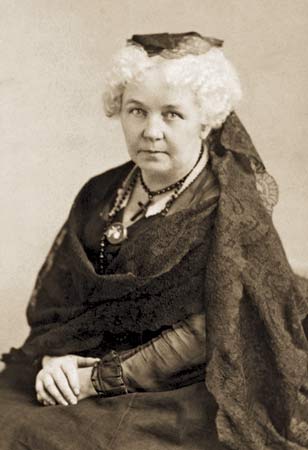
Personal Statement :
Hello, my name is Elizabeth Cady Stanton and I was born on November 12, 1815, in Johnstown, New York. I attended Johnstown Academy, where I studied Latin, Greek, mathematics, religion, science, French, and writing until the age of 16. After graduating the academy, I went on to Union College, as my older brother, Eleazar, had done previously. I am the daughter of a lawyer who made no secret of his preference for another son. That is the reason for my desire to study and be equal as all the other males. I graduated from the Emma Willard's Troy Female Seminary in 1832 and I am drawn to the abolitionist, temperance, and women's rights movements through visits to the home of my cousin, the reformer Gerrit Smith. I believed in the expansion of the Fifteenth Amendment which includes voting rights for all women,
this amendment also passed, as it was originally written, in 1870. I am also the author of the "Declaration of Rights and Sentiments" which granted rights to women and African Americans.
Issue(s) :
With Lucretia Mott and several other women, I held the Seneca Falls Convention in July 1848. At this meeting, we prepared the “Declaration of Sentiments” and took the lead in proposing that women be granted the right to vote. This declaration proposed grand movement for attaining the civil, social, political, and religious rights of women. Together with Susan B. Anthony, we declined to support passage of the Fourteenth and Fifteenth Amendments to the United States Constitution. I opposed giving added legal protection and voting rights to African American men while women, black and white, were denied those same rights. I authored both The Woman's Bible and her autobiography, along with many articles and pamphlets concerning female suffrage and women's rights. During the Civil War I concentrated my efforts on abolishing African American rights, but afterwards I became even more successful in promoting women suffrage. In 1868, I worked with Susan B. Anthony on the Revolution, a militant weekly paper. We then formed the National Woman Suffrage Association (NWSA) in 1869. I was the NWSA’s first president - a position I held until 1890. The organization then merged with another suffrage group to form the National American Woman Suffrage Association. I served as the president of the new organization for two years. My stance on the issue with women and slave rights is that the prejudice against color, of which we hear so much, is no stronger than that against sex. It is produced by the same cause, and manifested very much in the same way. My source of motivation is organized Christianity, which relegated women to an unacceptable position in society.
Issue(s) :
With Lucretia Mott and several other women, I held the Seneca Falls Convention in July 1848. At this meeting, we prepared the “Declaration of Sentiments” and took the lead in proposing that women be granted the right to vote. This declaration proposed grand movement for attaining the civil, social, political, and religious rights of women. Together with Susan B. Anthony, we declined to support passage of the Fourteenth and Fifteenth Amendments to the United States Constitution. I opposed giving added legal protection and voting rights to African American men while women, black and white, were denied those same rights. I authored both The Woman's Bible and her autobiography, along with many articles and pamphlets concerning female suffrage and women's rights. During the Civil War I concentrated my efforts on abolishing African American rights, but afterwards I became even more successful in promoting women suffrage. In 1868, I worked with Susan B. Anthony on the Revolution, a militant weekly paper. We then formed the National Woman Suffrage Association (NWSA) in 1869. I was the NWSA’s first president - a position I held until 1890. The organization then merged with another suffrage group to form the National American Woman Suffrage Association. I served as the president of the new organization for two years. My stance on the issue with women and slave rights is that the prejudice against color, of which we hear so much, is no stronger than that against sex. It is produced by the same cause, and manifested very much in the same way. My source of motivation is organized Christianity, which relegated women to an unacceptable position in society.
Solution(s) :
My solutions to the unfair rights to women and African Americans was traveling to give lectures and speeches. I called for an amendment to the U.S. Constitution giving women the right to vote. I also worked with Anthony on the first three volumes of the History of Woman Suffrage (1881–6). With my daughter, Harriet Stanton Blatch, we published a critique, The Woman's Bible, which was published in two volumes. The first volume appeared in 1895 and the second in 1898. This brought considerable protest not only from expected religious quarters but from many in the woman suffrage movement.
Relationship to Others:
I am passionate about women's rights and equality, so I would feel comfortable sitting next to someone with a related opinion. I would also be comfortable sitting next to atavists with religious leanings supporting divorce rights, employment rights, and property rights for women. I believe fundamental sexism is part of organized Christianity. On the other hand, I would feel very uncomfortable sitting next to someone who would deny any rights to women and African Americans. Someone who believes women should obey the man and neglects women capability.


